Integrations.
Most organisations run on several systems that each hold part of the picture, and people who copy information between them. We connect them, so data moves on its own, stays in step and stops being retyped.

01About this service
DotPerformance connects the systems you run, so data moves on its own and stops being retyped: APIs, data feeds, exports and sign-in, between the software you use, your suppliers’ services and the systems we build.
02Why it works.
- Connection healthy
If a system stops responding, the change is held, retried and delivered, and we’re told straight away.
Change something in one system and watch it arrive in the other.Edit a customer’s address on the left. A moment later it reaches the system on the right, and every step is logged. Then try an outage.
Information is entered once.Today the same details are typed into several systems, and the copies slowly drift apart. Once they’re connected, a change made in one place reaches every system that needs it.
Updates happen straight away.Where it matters, information moves the moment it changes, rather than waiting for an overnight batch or a weekly export.
Older systems can be connected too.Not every system has a modern way in. Where one doesn’t, we connect through whatever it does offer, so it can stay in place while everything around it is joined up.
Every connection is monitored.We watch every connection. If a supplier’s system changes or stops responding, we know and start fixing it before your team notices.
Secure from end to end.Information travels encrypted, each connection only has the access it needs, and every exchange is logged.
Kept working when systems change.When one of the systems at either end is updated, we update the connection to match. That is what the annual fee covers.
03Who you’ll work with.
Simon leads it, with Mark building the connections and John on the systems at either end. You’ll talk it through with Simon and Paula.
![]()
Simon King
Head of Digital
Leads the integration work: how your systems fit together, and the platform that connects them.
![]()
Paula Hamilton
Client partner
Your main contact. She keeps the plan, the paperwork and every agreed change on track.
![Mark Wade]()
Mark Wade
Senior Developer
Builds the connections: the APIs, the data feeds and the checks between systems.
![John Beaty]()
John Beaty
Head of Systems
Your systems at either end, and the rules for what moves between them.
![]()
Claudiu Danila
Senior Developer
The connections built, tested and monitored.
![Dave Edis]()
Dave Edis
Senior Developer
Sign-in, access and the security of every connection.






04What you get.
- API connections
- Your systems, your suppliers’ services and the systems we build, linked directly.
- Data feeds and file exchanges
- For systems that share information in batches or files.
- Connections to older systems
- Through whatever way in each system offers.
- Single sign-on
- One login for your team across the systems you connect.
- Mapping and checks
- Information translated between systems and checked before it’s accepted.
- Monitoring and alerts
- Every connection watched, with problems caught and reported straight away.
- Retries and held changes
- Nothing is lost if a system is briefly unavailable.
- A log of every exchange
- What was sent, when, and whether it arrived.
- Updates when systems change
- Connections kept working as the systems at either end are updated.
05What it costs.
- An integrationConnecting two systems, built, tested and monitored, with an annual fee to keep each one running.
from£2,500plus £600 a year
From-prices, plus VAT, with a written figure before any work starts. For continuous care and development once it’s live, see Systems Teams.
06Compared to the alternatives.
There are several ways to keep systems in step, and each one suits someone.
- Retype it by hand.
No set-up and no fees, and fine for a handful of records. As volumes grow, it takes people’s time, the copies drift apart, and mistakes go unnoticed until they matter.
- An off-the-shelf connector tool.
Quick and inexpensive for simple, popular systems. It struggles with older systems, complex rules and high volumes, and when something fails it’s often your team who finds out.
- Us.
Connections built for your systems and your rules, monitored and kept working, from £2,500 plus VAT and £600 a year for each connection.
07Questions.
What is system integration?
System integration is connecting separate software systems so they share information automatically, usually through APIs, instead of people copying data between them. DotPerformance connects the systems an organisation already runs, so data moves on its own and stays in step.
Can DotPerformance connect to systems that don’t have an API?
Often, yes. Exports, imports, scheduled files and, where needed, a small service in between can bridge older systems that have no API of their own.
What happens when a connected system changes?
DotPerformance monitors every connection, so failures are seen quickly and the integration is updated as part of ongoing support, rather than discovered when the data stops arriving.
What has DotPerformance integrated?
Payroll systems with workforce portals for the Isle of Man Constabulary; ticketing, payments through SumUp, streaming and a kit partner’s shop into the FC Isle of Man app; and Ship2Man’s parcel platform with Manx Independent Carriers’ delivery network.
How much does an integration cost?
DotPerformance builds integrations from £2,500 plus VAT, with £600 a year to keep each one monitored and running. You get a written price before work starts.
Work.
Recent Systems & Integration work.
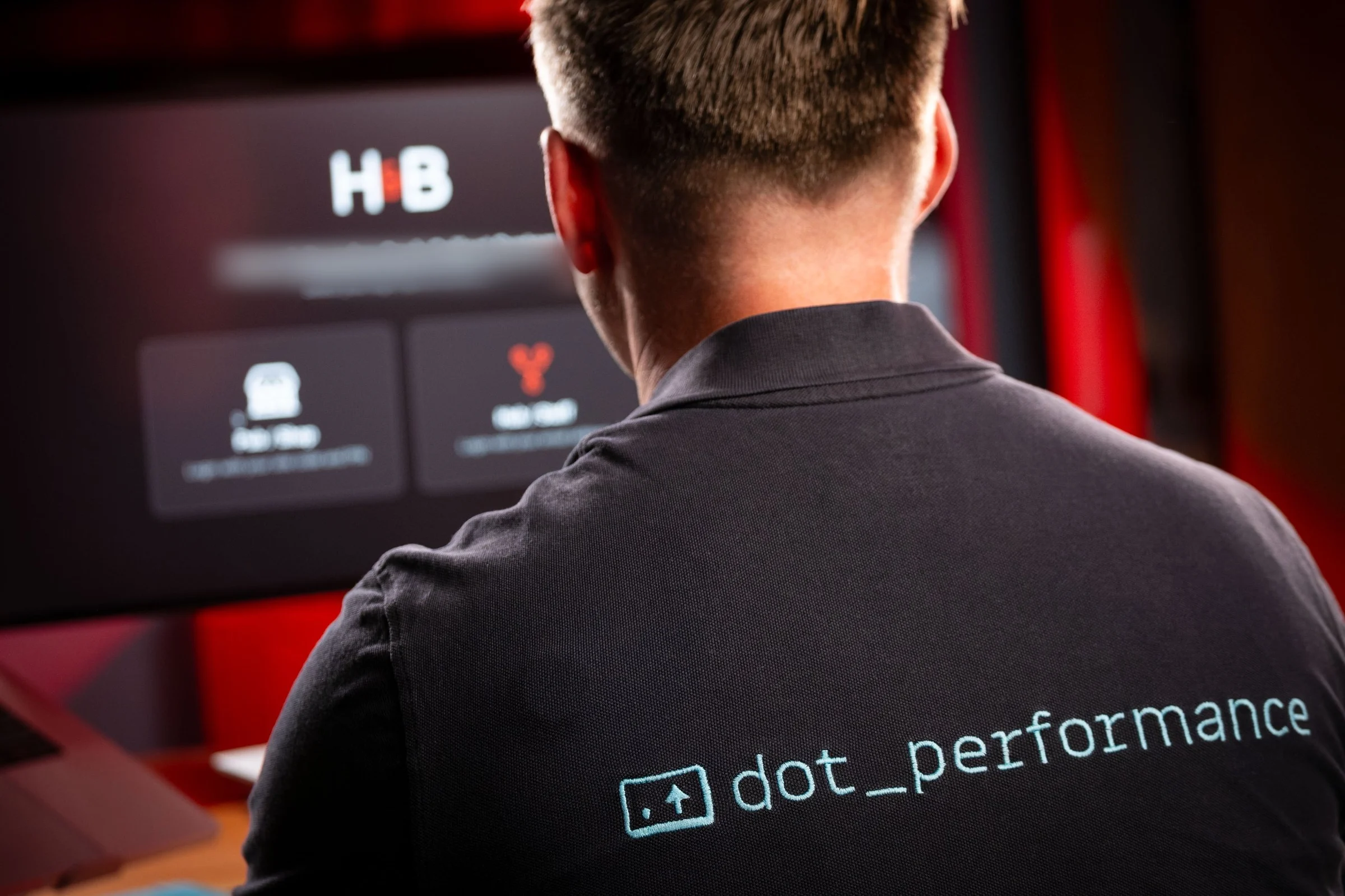
![A DotPerformance developer at the H&B app’s sign-in screen]()
![A large crowd of spectators at the Isle of Man TT, many checking their phones and cameras trackside during a race session]() Case study
Case studyIsle of Man TT Live Timing
The official live timing for the Isle of Man TT, on every phone around the course.
View![Two police officers in high-visibility jackets on duty, seen from behind]()
.webp)